Birthright Citizenship and the Return of Jus Sanguinis Thinking

The Supreme Court’s recent decision affirming birthright citizenship (Trump vs Barbara) surprised many Americans because of the radical historical position advanced by Justice Clarence Thomas. In his opinion, Thomas rejected the overwhelming historical understanding that the Fourteenth Amendment constitutionalized the long-established Anglo-American principle of jus soli — citizenship by birth on the nation’s soil.

The principle of jus soli did not originate with the Fourteenth Amendment. It was deeply rooted in English common law, inherited by the American colonies, and broadly recognized throughout the United States long before the 14 Amendment was drafted. In fact, the principle of citizenship by birthplace was so universally understood that the writers of the Constitution didn’t even see a need to spell it out in the original document. Following the constitutional catastrophe of Dred Scott v. Sandford (1857), the Reconstruction Congress adopted the Fourteenth Amendment to restore and permanently protect the traditional rule of birthright citizenship in the text of the US Constitution. The recognized exceptions remained narrow: children of foreign diplomats, children born on foreign public vessels, children of enemy occupying forces, and, at that time, children born to members of sovereign Indian tribes. Everyone else born on American soil was an American.

Justice Ketanji Brown Jackson correctly reminded the Court that the Citizenship Clause was not enacted solely for formerly enslaved Black Americans. While overturning the consequences of Dred Scott was unquestionably one of its principal purposes, Congress deliberately chose broad constitutional language that protected birthright citizenship generally rather than creating a limited guarantee applicable only to one group. Indeed, the 1866 debates demonstrate that lawmakers explicitly anticipated objections regarding the children of foreigners — including those here on a merely temporary visit — yet deliberately chose a universal guarantee that left no loophole for parental legal status.

Justice Thomas, however, advances a fundamentally different historical narrative. He fiercely argues that the Citizenship Clause should largely be understood as a measure intended only for formerly enslaved people. To defend this flawed and radical view, Thomas intentionally rejects over a century of binding legal precedent, most notably the Court’s 1898 decision in United States v. Wong Kim Ark, and gives little weight to the broader common-law tradition. By attempting to rewrite history, he completely glosses over the fact that the Court already settled the question of temporary visitors long ago. Rather than engaging with the broad reality of our common-law tradition, Thomas deliberately locks his interpretation into a narrow, manufactured window of time — stubbornly pretending the Fourteenth Amendment was merely a temporary, race-conscious remedy rather than the permanent, universal guarantee it was written to be. Many judges and legal experts disagreed with him, arguing that such a deeply flawed interpretation disregards both the common-law tradition and the historical record of the Reconstruction debates. By doing so, his dissent attempts to severely constrict a foundational American right that the Framers intentionally made absolute and all-inclusive.

What concerns me even more is the constitutional logic underlying the dissenting Justices’ position. In my reading, Justices Thomas, Samuel Alito, and Neil Gorsuch do not merely disagree about the meaning of the Fourteenth Amendment. They reject the traditional American understanding of citizenship that long predates the Amendment itself — and indeed predates the US Constitution. Their un-American approach would functionally replace the historic American rule of jus soli with a foreign hereditary principle resembling jus sanguinis, making a child’s citizenship depend entirely on the legal status of their parents.

That is precisely why I see an important historical parallel with Dred Scott. Before 1857, American law generally followed the English common-law tradition of jus soli. Dred Scott represented a radical break from that tradition by denying citizenship on the basis of ancestry and inherited status. The decision deliberately engineered a hereditary principle in order to preserve a cruel caste system.

Today, the dissenting Justices attempted a similar constitutional re-engineering. The category has changed — from enslaved parents to undocumented immigrant parents — but the legal method is strikingly similar. Rather than recognizing citizenship according to birthplace, they would make a child’s constitutional status depend on the status of their parents. This is a direct attempt to revive the same hereditary logic that Dred Scott shamefully employed, even though that vicious logic was repudiated by the Fourteenth Amendment and had never been part of the broader American constitutional tradition before 1857.

To be clear: today’s immigration system is not slavery. But both approaches rely on the exact same premise: that a child’s legal rights should depend on who their parents are, rather than where they were born. It was precisely that hereditary principle that the Fourteenth Amendment sought to reject by restoring the traditional American rule of birthright citizenship.

Fortunately, that effort did not prevail. The Court reaffirmed the constitutional principle of birthright citizenship. Yet I believe the dissent should serve as a warning. It does not simply propose a different reading of the Fourteenth Amendment; it challenges a legal tradition that stretches from English common law, through colonial America, through the Founding, and into Reconstruction.

For me, the historical irony is profound. In 1857, Chief Justice Roger Taney used twisted legal reasoning to deny citizenship to the descendants of enslaved people. Today, Justice Thomas embraces a worldview that would strip citizenship from children because of their parents’ immigration status.

The historical contexts are different, but the irony is inescapable. A Supreme Court Justice who has personally benefited from the constitutional transformation of the Reconstruction Amendments is now advocating an interpretation that would dismantle their most enduring guarantee: Birthright Citizenship!
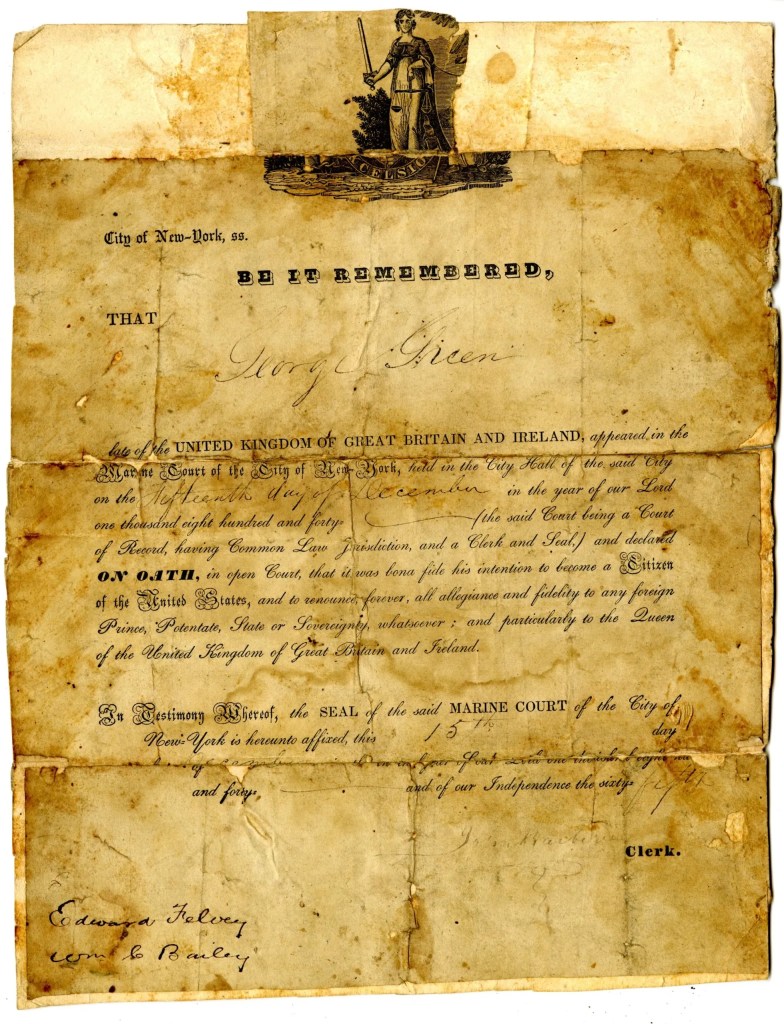
The Naturalization Act of 1795 — The Rising Barriers.

By 1795, the political climate of the young American Republic had shifted. Intensifying anxieties regarding foreign radicalism — particularly from revolutionary France and Ireland — led Congress to view new arrivals with increasing suspicion. The Naturalization Act of 1795 was designed to slow the pace of integration, significantly narrowing the pathway to citizenship for the «free white persons» eligible under federal law.
While the 1790 Act established the first federal framework, the 1795 legislation turned citizenship from a simple legal transition into a multi-step bureaucratic endurance test.

Administrative Barriers and Class Disparity.
The 1795 Act introduced hurdles that hit the working-class immigrant hardest. It formalized a mandatory two-step process: filing a «Declaration of Intent» (commonly known as «first papers») at least three years before a final application could even be considered. Furthermore, the total residency requirement was more than doubled, jumping from two years to five years. These requirements created a significant class divide. The Mobility Trap: For a labor force that followed seasonal work or canal projects, proving five years of continuous residency was often impossible.
Subjective Character Tests: Applicants had to appear before a «court of record» to prove their «good moral character.» This standard was often subjectively applied by local judges who could deny citizenship based on an immigrant’s poverty, political leanings, or lack of influential social connections.
As a result, a massive portion of the white immigrant population remained «factual non-citizens» throughout their lives. They integrated into local economies and farmed American land, but remained «alien» in the eyes of the law due to the sheer difficulty of the bureaucratic gauntlet.

The Racial and Social Legacy.
The 1795 Act explicitly reinforced the racial gatekeeping of its predecessor, limiting eligibility to «free white persons.» This created a sharp legal contrast within immigrant families. The Immigrant Parent: Faced high administrative barriers (if white) or an absolute legal barrier (if non-white).
The Native-Born Child: Held a status that predated the Constitution itself. In states like Massachusetts, a child born to a Black immigrant parent in 1796 was a citizen by birth, even as their parent was legally barred from ever naturalizing.

Correcting the Birthright Misconception.
A critical takeaway from this era is the persistence of birthright citizenship as a separate legal track, untouched by these rising naturalization barriers.
The Historical Reality: The 1795 Act made naturalization for adults significantly more difficult, but it did not — and legally could not — override the established principle of Jus Soli (right of the soil). The 14th Amendment’s eventual role in 1868 was not to «grant» this right for the first time, but to serve as a constitutional shield. It ensured that the «white only» logic of naturalization, which had been reinforced by the 1795 Act, could never be used to deny citizenship to non-white persons born within the United States. It took a pre-existing Northern reality and turned it into an unassailable national mandate.

Image source and (C): The Library of Virginia

American Citizenship During the First 14 Years of the Republic.

Before 1790, naturalization in the United States was a patchwork of inconsistent procedures, shaped by local politics, patronage, and varying state laws. This fragmentation created a legal vacuum that necessitated a uniform federal standard, eventually established by the Naturalization Act of 1790.
During this early period, formal citizenship was rarely a prerequisite for daily life. Many «free» white immigrants worked, rented property, and farmed while remaining active in their communities for decades without official papers. Local authorities often tolerated this situation, allowing for a form of «factual» integration that bypassed formal legal channels entirely. For the poor immigrant, acquiring formal citizenship was generally a secondary concern, unless they specifically sought to hold public office or secure the right to own and bequeath land in jurisdictions with strict «alien land laws».

The Birthright Divide: Jus Soli vs. Partus.
A common misconception today is that birthright citizenship was a «new» right created by the 14th Amendment in 1868. In reality, the U.S. had already been grappling with two competing legal traditions regarding birthright citizenship. The Northern Tradition (Jus Soli): In states like Massachusetts, New Hampshire, and Pennsylvania, the U.S. adhered to the English common-law doctrine of «right of the soil.» Under this principle, birth within U.S. territory automatically conferred citizenship, regardless of the parents’ legal status. In these states, children born to free Black parents were recognized as citizens from the beginning of the Republic.
The Southern Tradition (Partus Sequitur Ventrem): In states like Virginia and South Carolina, the common law was subverted by the Roman principle of «the offspring follows the womb.» This doctrine ensured that children born to enslaved women remained the property of their masters, effectively denying birthright citizenship to a large portion of the population and leaving free Black children in a precarious legal limbo.
The Historical Reality: The 14th Amendment of 1868 did not «invent» birthright citizenship; it nationalized the Northern tradition of Jus Soli. It protected a pre-existing reality — where a Black child born in Massachusetts was a citizen by birth — overruling the racial logic of the South and later rulings like Dred Scott (1857), which had sought to impose the Southern «womb-based» logic as the national standard.

The Naturalization Act of 1790: Federal Racial and Class Logic.
While the «soil» provided a path for children in some states, the Naturalization Act of 1790 created a rigid federal barrier for their parents. By limiting naturalization to «any alien being a free white person,» Congress ensured that the «earned» path to citizenship was a racial monopoly. However, even for «white» immigrants, the path was often blocked by class. The Property Barrier: Most states maintained property requirements for voting. A poor white immigrant might successfully naturalize under federal law but still be denied the right to vote if they did not own sufficient land.
The Family Gap: Under coverture, a white woman’s status followed her husband’s. For non-white families, no such «bridge» existed. A Black woman born abroad remained a permanent «alien» because she could not «lawfully naturalize» under the 1790 rule, even if she lived in a state that recognized her husband’s citizenship.
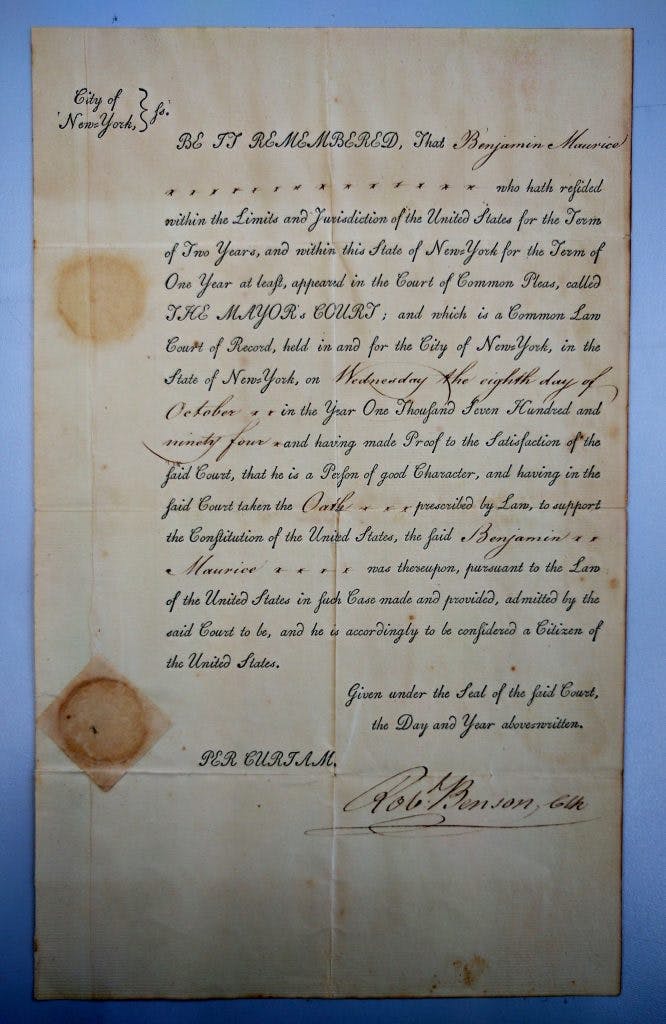
To bring order to the «patchwork» system, the Act of 1790 required:
Residency: Two years in the U.S. and one year in the state of application.
Character: Proof of «good character» presented to a court of record.
Allegiance: An oath to support the Constitution.
For the poor white laborer, these requirements — and the associated court fees — often felt unnecessary. They lived as «factual citizens,» participating in the economy and society, while their children became «legal citizens» automatically through birthright, despite the parents’ inability to afford or navigate the naturalization process. This left the adult immigrant in a state of perpetual legal limbo, while their children held a status the parents could never achieve.

Image Source and (C): The New York Historical