Birthright Citizenship and the Return of Jus Sanguinis Thinking

The Supreme Court’s recent decision affirming birthright citizenship (Trump vs Barbara) surprised many Americans because of the radical historical position advanced by Justice Clarence Thomas. In his opinion, Thomas rejected the overwhelming historical understanding that the Fourteenth Amendment constitutionalized the long-established Anglo-American principle of jus soli — citizenship by birth on the nation’s soil.

The principle of jus soli did not originate with the Fourteenth Amendment. It was deeply rooted in English common law, inherited by the American colonies, and broadly recognized throughout the United States long before the 14 Amendment was drafted. In fact, the principle of citizenship by birthplace was so universally understood that the writers of the Constitution didn’t even see a need to spell it out in the original document. Following the constitutional catastrophe of Dred Scott v. Sandford (1857), the Reconstruction Congress adopted the Fourteenth Amendment to restore and permanently protect the traditional rule of birthright citizenship in the text of the US Constitution. The recognized exceptions remained narrow: children of foreign diplomats, children born on foreign public vessels, children of enemy occupying forces, and, at that time, children born to members of sovereign Indian tribes. Everyone else born on American soil was an American.

Justice Ketanji Brown Jackson correctly reminded the Court that the Citizenship Clause was not enacted solely for formerly enslaved Black Americans. While overturning the consequences of Dred Scott was unquestionably one of its principal purposes, Congress deliberately chose broad constitutional language that protected birthright citizenship generally rather than creating a limited guarantee applicable only to one group. Indeed, the 1866 debates demonstrate that lawmakers explicitly anticipated objections regarding the children of foreigners — including those here on a merely temporary visit — yet deliberately chose a universal guarantee that left no loophole for parental legal status.

Justice Thomas, however, advances a fundamentally different historical narrative. He fiercely argues that the Citizenship Clause should largely be understood as a measure intended only for formerly enslaved people. To defend this flawed and radical view, Thomas intentionally rejects over a century of binding legal precedent, most notably the Court’s 1898 decision in United States v. Wong Kim Ark, and gives little weight to the broader common-law tradition. By attempting to rewrite history, he completely glosses over the fact that the Court already settled the question of temporary visitors long ago. Rather than engaging with the broad reality of our common-law tradition, Thomas deliberately locks his interpretation into a narrow, manufactured window of time — stubbornly pretending the Fourteenth Amendment was merely a temporary, race-conscious remedy rather than the permanent, universal guarantee it was written to be. Many judges and legal experts disagreed with him, arguing that such a deeply flawed interpretation disregards both the common-law tradition and the historical record of the Reconstruction debates. By doing so, his dissent attempts to severely constrict a foundational American right that the Framers intentionally made absolute and all-inclusive.

What concerns me even more is the constitutional logic underlying the dissenting Justices’ position. In my reading, Justices Thomas, Samuel Alito, and Neil Gorsuch do not merely disagree about the meaning of the Fourteenth Amendment. They reject the traditional American understanding of citizenship that long predates the Amendment itself — and indeed predates the US Constitution. Their un-American approach would functionally replace the historic American rule of jus soli with a foreign hereditary principle resembling jus sanguinis, making a child’s citizenship depend entirely on the legal status of their parents.

That is precisely why I see an important historical parallel with Dred Scott. Before 1857, American law generally followed the English common-law tradition of jus soli. Dred Scott represented a radical break from that tradition by denying citizenship on the basis of ancestry and inherited status. The decision deliberately engineered a hereditary principle in order to preserve a cruel caste system.

Today, the dissenting Justices attempted a similar constitutional re-engineering. The category has changed — from enslaved parents to undocumented immigrant parents — but the legal method is strikingly similar. Rather than recognizing citizenship according to birthplace, they would make a child’s constitutional status depend on the status of their parents. This is a direct attempt to revive the same hereditary logic that Dred Scott shamefully employed, even though that vicious logic was repudiated by the Fourteenth Amendment and had never been part of the broader American constitutional tradition before 1857.

To be clear: today’s immigration system is not slavery. But both approaches rely on the exact same premise: that a child’s legal rights should depend on who their parents are, rather than where they were born. It was precisely that hereditary principle that the Fourteenth Amendment sought to reject by restoring the traditional American rule of birthright citizenship.

Fortunately, that effort did not prevail. The Court reaffirmed the constitutional principle of birthright citizenship. Yet I believe the dissent should serve as a warning. It does not simply propose a different reading of the Fourteenth Amendment; it challenges a legal tradition that stretches from English common law, through colonial America, through the Founding, and into Reconstruction.

For me, the historical irony is profound. In 1857, Chief Justice Roger Taney used twisted legal reasoning to deny citizenship to the descendants of enslaved people. Today, Justice Thomas embraces a worldview that would strip citizenship from children because of their parents’ immigration status.

The historical contexts are different, but the irony is inescapable. A Supreme Court Justice who has personally benefited from the constitutional transformation of the Reconstruction Amendments is now advocating an interpretation that would dismantle their most enduring guarantee: Birthright Citizenship!
Jeremiah’s Tragedy: A Prophet Forced to Warn

Prophet Jeremiah is unique because he did not embrace his calling willingly. He was chosen against his will, drawn into a mission he did not want, and made to carry a burden that caused him deep personal pain. His first response was reluctance, because he knew the cost would be loneliness, rejection, grief, and suffering.

What makes his story even more tragic is that his resistance came from compassion. Jeremiah did not want to see his people destroyed. He did not want to witness Israel’s collapse or the Temple’s ruin. He would have spared them if he could, rather than become the messenger of disaster. That is what makes his calling so painful: he was forced to warn people about a judgment he desperately wanted to prevent.

Through Jeremiah, the king of Jews and the people of Israel were tested. God’s warning came through him, and the people’s rejection of Jeremiah became the evidence of their rejection of that warning. When they refused to listen, the judgment unfolded. Jeremiah became both messenger and sign — a reluctant test of whether the people would respond before it was too late.

So Jeremiah is not just a prophet of disaster; he is a reluctant witness to disaster. He bears the pain of seeing what he tried to prevent, and that makes his fate more tragic. Through him came the warning, through his rejection came the proof, and through his suffering came the full weight of the tragedy.

The Mind That Destroyed Itself: Hitler’s Fatal Contradiction and the Truth About Soviet Resistance

What Western Historians Usually Tell Us

The standard Western interpretation of Operation Barbarossa is elegant and widely accepted. Germany, the argument goes, faced a structural contradiction from the outset. It needed a rapid victory because it lacked the resources for a prolonged war against a major continental power. Yet its objectives—conquering or neutralizing the Soviet Union—were so vast that achieving them quickly was extraordinarily difficult.
When the Soviet Union failed to collapse in the opening weeks of June 1941, Germany’s strategic position began to deteriorate, even as it continued to win spectacular tactical and operational victories. Enormous encirclements at Kiev, Vyazma, and Bryansk destroyed entire Soviet armies, yet the state did not break. The Wehrmacht advanced hundreds of miles and still found more Soviet soldiers willing to fight.
This interpretation is not wrong. It is supported by serious historians—David Stahel, Adam Tooze, and Robert Citino—and grounded in genuine evidence of German resource constraints and Soviet institutional resilience. Germany simply did not have the industrial base, the fuel reserves, or the manpower to sustain a prolonged war on this scale.
But this explanation, for all its merits, is fundamentally incomplete. It treats Barbarossa merely as a miscalculation of logistics and scale. It misses something far deeper—something that gets to the very nature of the war Hitler chose to fight and explains why Soviet soldiers and civilians resisted with a ferocity that surprised even the most pessimistic German planners.

What the Standard Thesis Misses

To understand why the structural contradiction argument falls short, we need to ask a more basic question: why did Soviet resistance prove so tenacious at the human level?
The standard answer gestures toward Soviet institutional resilience, Stalin’s coercive apparatus, Russian geography, and German logistical overreach. These factors were real. But they do not fully explain why millions of ordinary Soviet citizens—many of whom had genuine grievances against Stalin’s regime—chose to resist so fiercely rather than acquiesce or collaborate.
The answer lies in the nature of the invasion itself.

A War Unlike Any Other in Europe

When Nazi Germany invaded Western Europe, it was brutal and destructive. But for most French, Dutch, or Belgian civilians, German occupation was survivable. Compliance, passivity, or even collaboration carried a reasonable chance of living through the conflict. This shaped the choices millions of people made. It is not a question of French weakness or Belgian cowardice—it is a question of rational calculation under conditions where surrender remained a viable option.
The Eastern Front was categorically different.
From the very beginning, Nazi policy targeted entire categories of Soviet people not for subjugation, but for annihilation or elimination:

  • Jews faced systematic murder through the Einsatzgruppen death squads and, later, the machinery of the Holocaust. There was no survivable path under German rule.
  • Communist officials and political commissars were to be executed upon capture under the Commissar Order—a direct instruction to kill rather than imprison.
  • Soviet prisoners of war died by the millions in German captivity through deliberate starvation and neglect. Of the roughly 5.7 million Soviet soldiers captured, more than 3 million died—a death rate that communicated clearly to every soldier still fighting what surrender meant.
  • Slavic populations broadly faced the long-term vision of Generalplan Ost: mass displacement, starvation under the Hunger Plan, and the transformation of Eastern Europe into German colonial territory.
    As these policies became visible—through mass shootings witnessed by surviving villagers, through the fate of POWs, and through the conduct of German forces in occupied territories—millions of Soviet citizens arrived at the same conclusion: whatever their feelings about Stalin, a German victory meant their death, enslavement, or dispossession.
    This is the key insight that the standard structural contradiction thesis underweights. The determination of Soviet resistance was not primarily a product of Communist ideology, Russian cultural toughness, or Stalinist coercion alone. It was, in significant part, a rational response to a genuinely exterminatory threat. People fight differently when surrender is not a survivable option.

The Great Strategic Paradox

This produces one of the most profound strategic paradoxes of the Second World War.
Hitler launched Barbarossa partly on the assumption that Soviet society was an artificial construction held together only by terror—that diverse Soviet peoples, many of whom genuinely hated Stalinist rule, would welcome or at least accept German liberation. He was not entirely wrong about the grievances. Ukrainians remembered the Holodomor. Baltic populations resented Soviet annexation. Many ordinary citizens had suffered under collectivization and the purges. In the early weeks of the invasion, some populations did greet German forces with a degree of relief.
Hitler had real political material to work with. He threw it away entirely.
Because his racial ideology was non-negotiable, the conduct of the occupation systematically eliminated any alternative to resistance. The very people who might have remained neutral, or even collaborated against Stalin, were given an unmistakable demonstration of what German victory would mean for them. Whatever their views of the Soviet regime, a German victory posed an existential threat to their survival.
Nazi policy did not exploit the divisions within Soviet society. It healed them.

Hitler’s Mind as the Fatal Variable

This brings us to the deepest explanation of German defeat—one that goes beyond logistics, beyond operational errors, and beyond the question of whether German generals should have pressed toward Moscow in August 1941 rather than turning south toward Kiev.
Hitler’s ideology was simultaneously the motivation for Barbarossa and the mechanism of its failure.
He needed rapid military victory because Germany lacked resources for a long war. He needed political collapse or acquiescence from Soviet populations to achieve that rapid victory. But his ideology made that acquiescence impossible—because it demanded the murder, enslavement, or displacement of those same populations. The racial war he needed to fight for ideological reasons was precisely what prevented the political collapse he needed for military success.
This is not a case of a rational strategy poorly executed. It is a case of a mindset that contained its own destruction. The objectives Hitler set were not merely ambitious—they were self-defeating at the foundational level. You cannot ask people to accept your victory when your victory means their annihilation.
When Hitler assumed personal command of the Army in December 1941, dismissing Brauchitsch and the professional military leadership, he was not introducing a new fatal flaw. The fatal flaw was already there, embedded in the ideological character of the war from the first day. No general could have overcome it, because the very thing that manufactured Soviet resistance—the genocidal conduct of the occupation—was the one thing Hitler would never negotiate away.

What Western Historiography Has Muted

There is a broader historiographical point worth making. Western military history has been remarkably slow to center this analysis.
Part of the explanation lies in Cold War politics, which made emphasizing Soviet resilience and sacrifice ideologically uncomfortable. Part of it lies in the postwar influence of German generals’ memoirs—men like Halder and Guderian who constructed a narrative in which professional military judgment was sound and Hitler’s personal interference was the sole cause of defeat. This «clean Wehrmacht» myth served obvious self-interested purposes and was absorbed into Western military thinking at a time when American doctrine was eager to learn from German operational excellence.
The result is a historiography that emphasizes logistical constraints, operational errors, and the famous debates about Moscow versus Kiev—while treating the genocidal character of the occupation as a moral footnote rather than a central strategic fact.
But the genocidal character of the occupation was not a footnote. It was the engine that drove Soviet resistance. It was the reason millions of people who might have stood aside chose instead to fight. It is the reason the structural contradiction thesis, for all its merits, gives an incomplete account of why Germany lost.

Conclusion

The defeat of Operation Barbarossa was not simply a failure of logistics or a miscalculation of Soviet resilience. At its deepest level, it was the product of an ideology that destroyed the conditions for the victory it demanded.
Hitler believed he was invading a rotten structure that would collapse under pressure. Instead, the character of his invasion—its racial hierarchy, its exterminatory policies, its treatment of prisoners and civilians—communicated to millions of Soviet people that there was no survivable future under German rule. It transformed a war of conquest into, for vast numbers of Soviet citizens, a war of survival.
The soldiers defending Stalingrad, the partisans in the forests of Belarus, the civilians enduring the siege of Leningrad—they were not fighting primarily for Stalin. Many of them were fighting because the alternative, as Nazi policy had made unmistakably clear, was something worse than the war itself.
That is the truth about Soviet resistance that Western military history has too often suppressed, softened, or simply failed to see.

Chiaroscuro: The Light of Faith vs. The Light of Regret

In Saint Sebastian (Régnier): The sharp beam of light cutting through the pitch-black darkness represents divine, heavenly grace. Sebastian is in intense physical pain, but the light illuminates his face as he looks upward, connecting him directly to God. The light here is a rescue; it elevates him above his suffering and promises eternal life.


In The Neophyte (Doré): The light here is not holy. It is a harsh, isolating spotlight exposing a devastating mistake. Instead of connecting the young monk to heaven, the light isolates him in his silent panic, acting as a fading echo of the bright, free world he just gave up.

Régnier was a massive fan of the legendary Italian painter Caravaggio, who popularized chiaroscuro—that intense contrast where the background is pitch black and the subject is blasted with a sharp, dramatic beam of light.

Doré used a classic theatrical painting technique called chiaroscuro to achieve exactly the same but opposite. By bathing the young novice in that crisp, clean, illuminated white light while casting the older monks in muddy, decaying, shadow-filled earth tones, he visually separates them by a lifetime.

Régnier’s Baroque Drama: The drama is external and physical. There are literal arrows piercing the skin. Yet, the lighting softens the horror, giving the martyr a beautiful, almost serene glow. The message is about the triumph of the soul over physical torture.

Doré’s Romantic Tragedy: The drama is entirely internal and psychological. There is no blood, no physical violence—just a group of men sitting in a row. Yet, the contrast between the young man’s brightly lit, terrified face and the dark, shadowy, tomb-like figures of the older monks creates a feeling of being buried alive.

Régnier uses darkness to block out the rest of the world so you can focus entirely on a saint’s spiritual ecstasy. Doré uses darkness to crowd in around a young man, visualizing the crushing weight of a lifetime prison sentence.

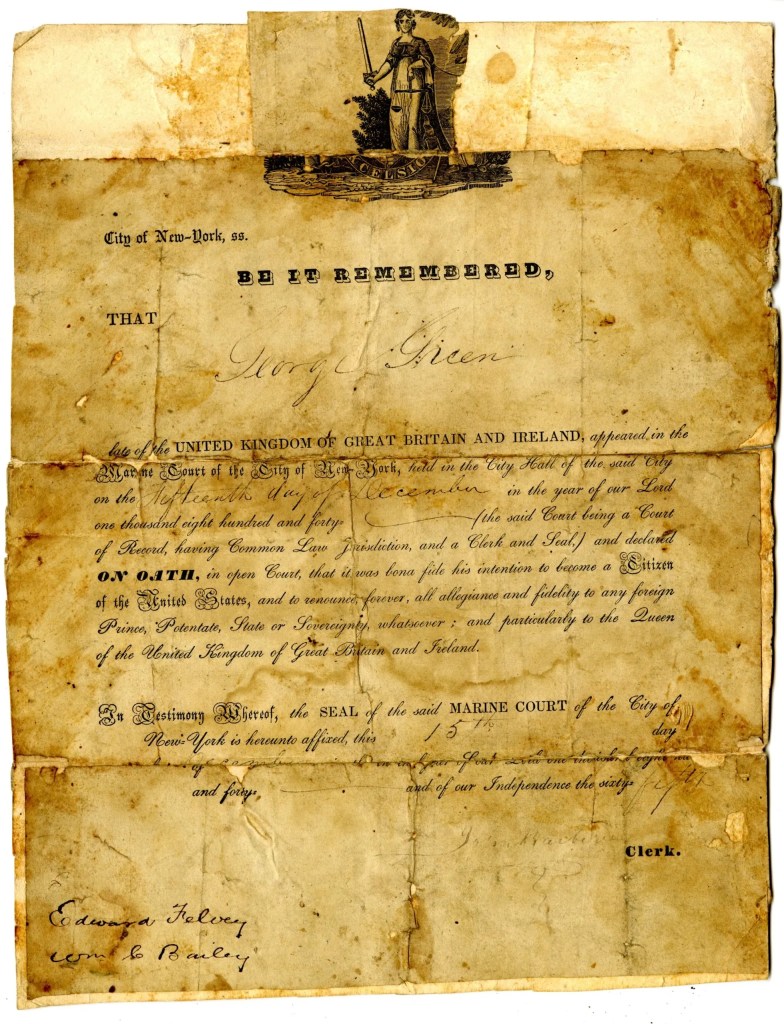
The Naturalization Act of 1795 — The Rising Barriers.

By 1795, the political climate of the young American Republic had shifted. Intensifying anxieties regarding foreign radicalism — particularly from revolutionary France and Ireland — led Congress to view new arrivals with increasing suspicion. The Naturalization Act of 1795 was designed to slow the pace of integration, significantly narrowing the pathway to citizenship for the «free white persons» eligible under federal law.
While the 1790 Act established the first federal framework, the 1795 legislation turned citizenship from a simple legal transition into a multi-step bureaucratic endurance test.

Administrative Barriers and Class Disparity.
The 1795 Act introduced hurdles that hit the working-class immigrant hardest. It formalized a mandatory two-step process: filing a «Declaration of Intent» (commonly known as «first papers») at least three years before a final application could even be considered. Furthermore, the total residency requirement was more than doubled, jumping from two years to five years. These requirements created a significant class divide. The Mobility Trap: For a labor force that followed seasonal work or canal projects, proving five years of continuous residency was often impossible.
Subjective Character Tests: Applicants had to appear before a «court of record» to prove their «good moral character.» This standard was often subjectively applied by local judges who could deny citizenship based on an immigrant’s poverty, political leanings, or lack of influential social connections.
As a result, a massive portion of the white immigrant population remained «factual non-citizens» throughout their lives. They integrated into local economies and farmed American land, but remained «alien» in the eyes of the law due to the sheer difficulty of the bureaucratic gauntlet.

The Racial and Social Legacy.
The 1795 Act explicitly reinforced the racial gatekeeping of its predecessor, limiting eligibility to «free white persons.» This created a sharp legal contrast within immigrant families. The Immigrant Parent: Faced high administrative barriers (if white) or an absolute legal barrier (if non-white).
The Native-Born Child: Held a status that predated the Constitution itself. In states like Massachusetts, a child born to a Black immigrant parent in 1796 was a citizen by birth, even as their parent was legally barred from ever naturalizing.

Correcting the Birthright Misconception.
A critical takeaway from this era is the persistence of birthright citizenship as a separate legal track, untouched by these rising naturalization barriers.
The Historical Reality: The 1795 Act made naturalization for adults significantly more difficult, but it did not — and legally could not — override the established principle of Jus Soli (right of the soil). The 14th Amendment’s eventual role in 1868 was not to «grant» this right for the first time, but to serve as a constitutional shield. It ensured that the «white only» logic of naturalization, which had been reinforced by the 1795 Act, could never be used to deny citizenship to non-white persons born within the United States. It took a pre-existing Northern reality and turned it into an unassailable national mandate.

Image source and (C): The Library of Virginia

American Citizenship During the First 14 Years of the Republic.

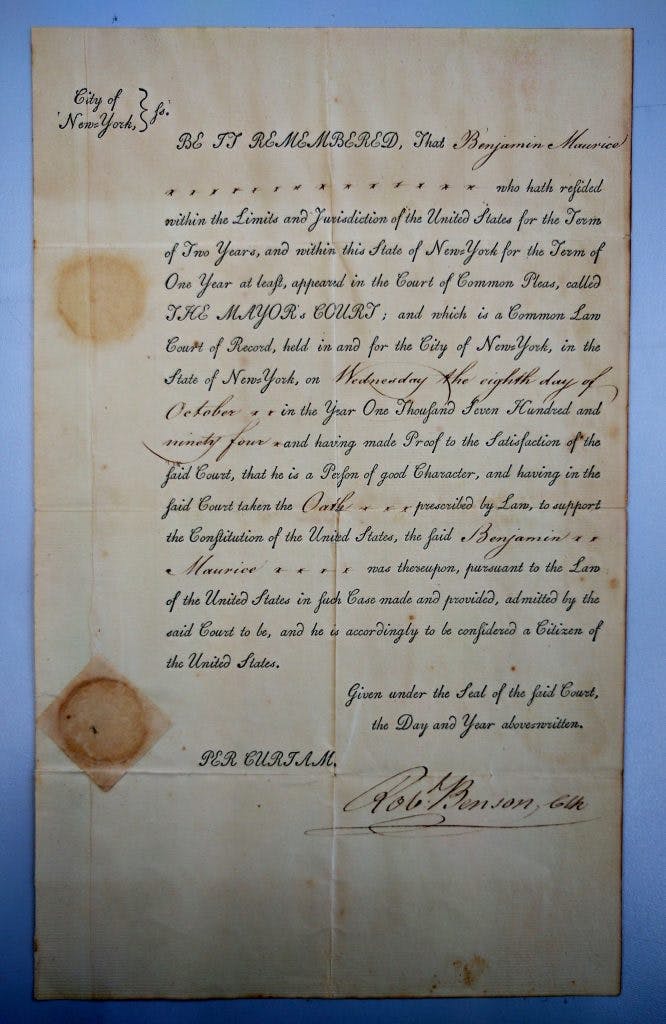
Before 1790, naturalization in the United States was a patchwork of inconsistent procedures, shaped by local politics, patronage, and varying state laws. This fragmentation created a legal vacuum that necessitated a uniform federal standard, eventually established by the Naturalization Act of 1790.
During this early period, formal citizenship was rarely a prerequisite for daily life. Many «free» white immigrants worked, rented property, and farmed while remaining active in their communities for decades without official papers. Local authorities often tolerated this situation, allowing for a form of «factual» integration that bypassed formal legal channels entirely. For the poor immigrant, acquiring formal citizenship was generally a secondary concern, unless they specifically sought to hold public office or secure the right to own and bequeath land in jurisdictions with strict «alien land laws».

The Birthright Divide: Jus Soli vs. Partus.
A common misconception today is that birthright citizenship was a «new» right created by the 14th Amendment in 1868. In reality, the U.S. had already been grappling with two competing legal traditions regarding birthright citizenship. The Northern Tradition (Jus Soli): In states like Massachusetts, New Hampshire, and Pennsylvania, the U.S. adhered to the English common-law doctrine of «right of the soil.» Under this principle, birth within U.S. territory automatically conferred citizenship, regardless of the parents’ legal status. In these states, children born to free Black parents were recognized as citizens from the beginning of the Republic.
The Southern Tradition (Partus Sequitur Ventrem): In states like Virginia and South Carolina, the common law was subverted by the Roman principle of «the offspring follows the womb.» This doctrine ensured that children born to enslaved women remained the property of their masters, effectively denying birthright citizenship to a large portion of the population and leaving free Black children in a precarious legal limbo.
The Historical Reality: The 14th Amendment of 1868 did not «invent» birthright citizenship; it nationalized the Northern tradition of Jus Soli. It protected a pre-existing reality — where a Black child born in Massachusetts was a citizen by birth — overruling the racial logic of the South and later rulings like Dred Scott (1857), which had sought to impose the Southern «womb-based» logic as the national standard.

The Naturalization Act of 1790: Federal Racial and Class Logic.
While the «soil» provided a path for children in some states, the Naturalization Act of 1790 created a rigid federal barrier for their parents. By limiting naturalization to «any alien being a free white person,» Congress ensured that the «earned» path to citizenship was a racial monopoly. However, even for «white» immigrants, the path was often blocked by class. The Property Barrier: Most states maintained property requirements for voting. A poor white immigrant might successfully naturalize under federal law but still be denied the right to vote if they did not own sufficient land.
The Family Gap: Under coverture, a white woman’s status followed her husband’s. For non-white families, no such «bridge» existed. A Black woman born abroad remained a permanent «alien» because she could not «lawfully naturalize» under the 1790 rule, even if she lived in a state that recognized her husband’s citizenship.
To bring order to the «patchwork» system, the Act of 1790 required:
Residency: Two years in the U.S. and one year in the state of application.
Character: Proof of «good character» presented to a court of record.
Allegiance: An oath to support the Constitution.
For the poor white laborer, these requirements — and the associated court fees — often felt unnecessary. They lived as «factual citizens,» participating in the economy and society, while their children became «legal citizens» automatically through birthright, despite the parents’ inability to afford or navigate the naturalization process. This left the adult immigrant in a state of perpetual legal limbo, while their children held a status the parents could never achieve.

Image Source and (C): The New York Historical